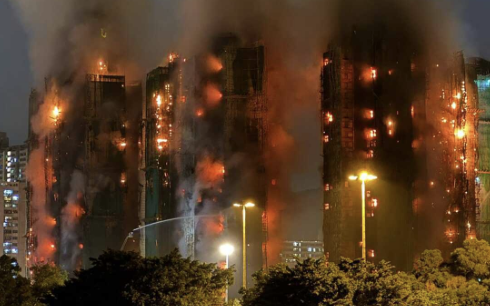
Hong Kong’s Deadliest High-Rise Fire in Decades Rips Through Wang Fuk Court
On November 26, 2025, a massive fire broke out at the Wang Fuk Court residential complex in the Tai Po district of Hong Kong’s New Territories. What began as a fire on the exterior scaffolding of one tower quickly spiralled into a catastrophic blaze that spread across seven of the eight towers in the estate. The fire turned an active renovation site into a scene of horror.
The fire was first reported at 2:51 p.m. local time, at a block known as “Wang Cheong House.” At that time, the building was undergoing renovation. The exterior was covered in bamboo scaffolding and protective mesh netting, and many units had external foam-based insulation panels installed. These materials were flammable and poorly protected, allowing the fire to spread quickly.
Within hours, flames and thick smoke engulfed adjacent towers. Strong winds exacerbated the situation, fanning the flames and helping the fire to leap from building to building. Rescue teams described intense heat, falling debris, and dangerously unstable scaffolding; conditions that made it nearly impossible to enter higher floors safely.
Rescue Efforts and the Heavy Toll
Emergency services responded with a massive mobilization. Hundreds of firefighters, dozens of fire trucks and ambulances, police officers, and rescue personnel from across Hong Kong rushed to the scene. As the night fell, the fire upgraded to a Level 5 Alarm, which was the highest possible alert, reflecting the severity of the situation.
Rescuers battled flames for over 40 hours. Many residents were trapped, some calling for help from the windows or stairwells, others unable to escape due to the smoke or blocked exits. Firefighters used skyladders and trucks to reach the upper floors, but the thick smoke, falling scaffolding, and intense heat made many areas unreachable.
As of November 29, officials confirmed that at least 128 people have died, including a firefighter who lost his life during the rescue efforts. Over 70 more were injured, among them several firefighters suffering from burns or smoke inhalation. Tragically, authorities say around 200 people remained unaccounted for, with many feared dead.
Rooms that once held families and memories were reduced to charred shells. In some towers, bodies were still being recovered days after the blaze. Among the victims were local residents, elderly people, and foreign domestic workers; illustrating how widespread the human impact was across different communities.
Why the Fire Spread So Quickly
First, the building materials used in the renovation. Bamboo scaffolding wrapped in mesh netting, plus foam insulation panels were extremely flammable. Once ignited, they acted like kindling, allowing flames to race upward and outward in minutes.
Second, safety systems failed. Reports indicate that fire alarms in the towers did not function during the fire. This failure denied many residents the warning time they would normally get to evacuate, dramatically reducing their chance of escape.
Third, rescue was made harder by the layout of the complex: tightly packed towers, narrow stairwells, and dense housing arrangements. With smoke filling hallways and debris blocking exits, many residents, especially those on higher floors, had no safe route out.
Finally, the renovation itself likely contributed to structural hazards. Some of the plastic foam boards installed around window frames may not have met fire-resistance standards. Investigators suspect these materials helped the fire spread from outside scaffolding into interior apartment units.
Investigation, Arrests, and Outrage
As survivors and rescuers sifted through the wreckage, authorities began investigating the cause of the fire and possible negligence. Within days, several individuals linked to the renovation project were arrested. Initial charges include manslaughter and suspected corruption related to use of unsafe building materials.
Officials confirmed that scaffolding and protective netting used during renovation did not meet required fire-safety standards. Investigators also found foam panels installed along windows, an addition that may have accelerated the fire’s spread inside the apartments.
Government agencies have begun city-wide safety inspections of other residential complexes undergoing renovation, to ensure scaffolding and materials meet proper fire safety codes. These inspections reflect growing public anger and fear that Hong Kong’s dense housing environment combined with lax oversight, could lead to more tragedies.
Residents and community leaders have voiced frustration: many say they had raised previous concerns about fire hazards, especially around renovation works, but feel their warnings were ignored. The tragedy has also sparked anger over possible corruption in the construction industry, and renewed calls for stricter enforcement of building-safety laws.
Lasting Impact: Shock, Mourning, and Calls for Change
The fire at Wang Fuk Court will leave a long shadow over Hong Kong. The scale of the tragedy, marked by the high death toll, the number of missing people, and the destruction of homes, has shaken public faith in housing safety. Many families have lost loved ones, others have lost their homes. Entire communities are in mourning.
Beyond grief, residents are demanding accountability. They want better safety standards, more transparent inspection procedures, and greater oversight on renovation and construction companies. The arrests have provided a start, but for many survivors and families of victims, that is not enough – they want systemic change.
The event has also sparked fear in other housing estates across Hong Kong. People are now watching renovation projects closely, checking whether their buildings use safe materials, and calling for fire-safety inspections where none have been done. For some, the fire at Wang Fuk Court is a warning, acting as a crucial reason to demand change before more lives are lost.
Resources
“At least 13 dead as fire engulfs Hong Kong high-rise residential buildings.” Al Jazeera, 26 Nov 2025, https://www.aljazeera.com/news/2025/11/26/at-least-13-dead-as-fire-engulfs-hong-kong-high-rise-residential-buildings
“Death toll in Hong Kong blaze rises to 146 after more bodies found.” ABC News, 30 Nov 2025, https://www.abc.net.au/news/2025-11-30/hong-kong-blaze-death-toll-rises-after-more-bodies-found/106084440
“Rescue efforts end at Hong Kong tower block fire as death toll reaches 128.” The Guardian, 28 Nov 2025, https://www.theguardian.com/news/2025/nov/28/hong-kong-apartment-fire-response-rescue-operations-death-toll
“Hong Kong tower block fire death toll rises to 44 with hundreds still missing.” The Guardian, 26 Nov 2025, https://www.theguardian.com/world/2025/nov/26/hong-kong-fire-tai-po-towers
“Hong Kong tower fire toll rises to 128; 200 remain missing.” The Business Standard (TBS News)/Reuters, 28 Nov 2025, https://www.tbsnews.net/world/hong-kong-fire-death-toll-rises-94-almost-300-still-missing-1296826
“Fire in Hong Kong high-rise complex kills at least 55, leaves hundreds missing.” Al Jazeera, 26 Nov 2025, https://www.aljazeera.com/news/2025/11/26/at-least-13-dead-as-fire-engulfs-hong-kong-high-rise-residential-buildings
“Fire in Hong Kong residential high-rise, hundreds trapped, officials say.” CBS News, 26 Nov 2025, https://www.cbsnews.com/news/fire-hong-kong-residential-high-rise-dead-trapped/
“Death toll rises to 128 in Hong Kong residential fire as 8 more arrested over towers’ renovation.” Toronto CityNews / AP, 27 Nov 2025, https://www.toronto.citynews.ca/2025/11/27/dozens-more-bodies-recovered-after-hong-kong-blaze-raising-death-toll-to-128/