Holidays Around Christmas Time
There are lots of different celebrations that take place around Christmas time. Some of those celebrations include Hanukkah, Kwanzaa, New Year’s Eve, Boxing Day, Winter Solstice, Las Posadas, St. Nicholas Day, and Yule. Below, I will discuss a few of these.
Hanukkah
Hanukkah is a Jewish Festival of Lights that celebrates the rededication of the Second Temple in Jerusalem. In 175 B.C., King Antiochus’ ancient kingdom included Judea, which is now located in Israel. He made the practice of Judaism against the law. Instead, he wanted the people to worship the Greek Gods. When the people refused, he sent his troops to destroy the Temple of Jerusalem, which was a place of worship for the Jewish people. He replaced it with an altar dedicated to Zeus. The Jewish people, led by Judah the Maccabees, rebelled against King Antiochus. Many historians believe that they fought for three years before becoming an independent region so they could freely practice their religion. Around 164 B.C., the Maccabees, a group of rebels, defeated King Antiochus and his troops. When the Maccabees returned to their destroyed temple, they found a jar of oil, with only enough to light the candles for one day. However, according to one of Judaism’s holy texts, it burned for eight days, enough time to find more oil for the sacred candles.
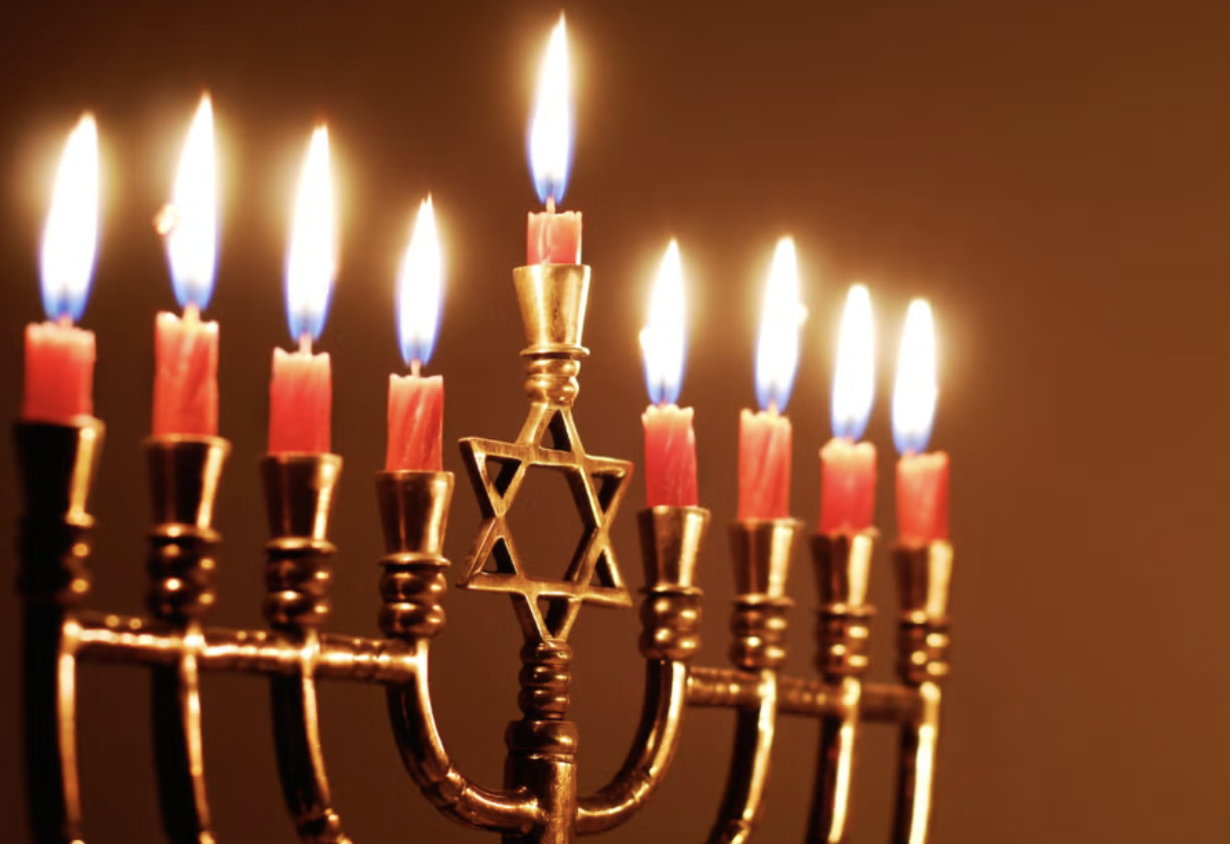
Hanukkah starts on the 25th day of the ninth month of the Hebrew calendar. Because this calendar follows the lunar cycle, the holiday begins on a different date each year. Usually, Hanukkah starts in late November to mid-December. The dates this year are from the evening of Sunday, December 14, 2025, to Monday, December 22, 2025. To celebrate the miracle of the oil burning a candle for eight nights, the Jewish people celebrate Hanukkah by lighting a candleholder called a menorah for eight nights. The menorah holds nine candles—one for each night, plus a candle called the shamash, which is used to light the other candles. On the first night of Hanukkah, one candle is added to the menorah and lit. The next night, another one is added and lit. The additions and lighting of the candles continue for eight nights. During these times, people recite blessings and prayers, sing songs and exchange gifts to celebrate the ancient miracle from over 2,000 years ago. The traditional foods that are eaten during this time include jelly doughnuts called sufganiyot and pancakes called latkes. Both are fried to represent the long-lasting oil. After they have eaten, families take turns spinning a top called a dreidel. They can win chocolate gelt or coins depending on which symbol the dreidel lands on.
Kwanzaa
Kwanzaa is celebrated every year from December 26th to January 1st. Kwanzaa is a week of festive activities honouring African American culture and heritage. Friends and family gather every day to give thanks, exchange gifts, and share a meal together. The holiday was created in 1966, during a period of time when many Black people faced mistreatment and systemic discrimination because of the colour of their skin. The holiday is meant to honour African Americans and their struggles in the US.
Throughout the 1950s and 1960s, the civil rights movement sought to end the mistreatment of people based on skin colour and race. In 1954, the Supreme Court ruled that teaching children with different skin colours separately was illegal. In 1963, Martin Luther King Jr. gave his “I Have a Dream” speech. The Civil Rights Act of 1964 and the Voting Rights Act of 1965 helped ensure there were more equal rights for African Americans. Unfortunately, many people still faced discrimination. In 1965, a police officer pulled over two African American men in a neighbourhood called Watts, in Los Angeles, California. A crowd gathered to protest because of how police were treating the people in the community. The crowd grew big and angry, lasting for six days of protests and riots all over the city. Thirty-four people were killed, and over a thousand were injured in what has now been called the Watts Rebellion.
The following year, an activist named Maulana Karenga wanted to rebuild the neighbourhoods affected by the riots and to encourage pride. He created Kwanzaa to encourage African Americans to honour their African roots. Kwanzaa means “first fruits” in Swahili, and it refers to the joy and unity many African individuals feel when celebrating. The holiday encourages people to honour several principles: unity, self-determination, teamwork, sharing, purpose, creativity, and faith. Kwanzaa is not an African holiday, but it is inspired by many African cultural practices. Symbols of African heritage are used for decorations during Kwanzaa. For example, families will place a traditional woven mat called a mkeka on tables to represent the two traditions on which the holiday is based: sharing and faith. A basket with fruits and vegetables, along with an ear of corn for each child in the family, will be placed on the table. A kikombe cha umoja, or a unity cup, is also placed on the mkeka.
A huge part of celebrating is lighting a candle each night. First, an adult pours a bit of water or juice from the unity cup on the ground to remember the ancestors who came before them. Then the cup will be passed around to each family member, as they take a sip while everyone chants “harambee” (“let’s pull together” in Swahili) seven times. The kinara holds seven candles, one black, three red, and three green. The black one in the middle represents unity among people of African descent, while the red on the left represents the past, and the green candles on the right symbolize the future. Each day, people gather to light a special candle that represents one of the seven principles of Kwanzaa. On the first night, they light the black candle. Each night, a different candle is lit to reflect on the remaining principles.
The food that people eat is made using recipes that have been passed down for many years. Meals include dishes like peanut soup, shrimp gumbo, and desserts like fried bananas, sweet potato pie, and coconut sweets. Although Kwanzaa lasts for a whole week, the major celebration typically occurs on December 31st. That’s when everyone gathers in bright clothing with traditional African-style patterns and has a huge feast called karamu. They play music, dance, and sing. While the 31st is very lively and celebrated, the last day is much quieter. On January 1, people focus on how they want to be in the coming year and what kind of person they aspire to be in the future.
Yule
Yule is a winter festival created by the Germanic peoples. It occurs around the time of the winter solstice, which takes place between December 21st and 22nd in the Northern Hemisphere and between June 20th and 21st in the Southern Hemisphere. In many languages of Northern Europe, “Yule” is the word for Christmas. The origin of the festival is not clear, but it was celebrated in Scandinavia and other European regions.
Yule is among the oldest known winter festivals, with origins traced back to the ancient Norse from thousands of years ago. Though its roots are quite complicated to trace back, there are a couple of theories that cover why and how it was celebrated. Most theories generally suggest that Yule celebrations originated as a Norse festival known as jól, although the purpose and traditions varied. The themes of light, fire, and feasts are common in festivals much like these during the wintertime. Some historians believe that sacrifices were also part of the tradition, which could be made to gods, other beings, such as elves, or the dead. In the climate of northern Europe, many cattle were killed before winter because they could not be provided with food during the cold months. This could explain why there were plenty of meat options for a feast or as an offering at the winter solstice.
Some believe that the festival originally had a Norse Day of the Dead aspect. Odin was a God associated with death and the afterlife, and he possessed numerous names, including Jólnir. A historian has recently proposed that jól was a New Year’s festival. One of the earliest mentions of Yule comes from an English monk and historian named Bede, who wrote in the 8th century about a period in the old pagan calendar used by groups such as the Norse and the Anglo-Saxons. This period was called Giuli, and it was a two-month span that marked the time when sunlight began to grow stronger around the winter solstice. It was not a festival, but rather a way of marking time.
Yule became a secondary name for Christmas around the 9th century, and it is still used to describe the holiday today—jul in Norwegian, Swedish, and Danish; jõulud in Estonian; joulu in Finnish; and jól in Icelandic. Christmas is also still referred to as Yule in the Scottish language. According to King Haakon Haraldsson of Norway, Yule and Christmas merged during his reign. Haakon converted to Christianity after visiting England, and upon returning to Norway, he established a law requiring Yule to be celebrated at the same time as Christmas. After this point, Christmas gradually overtook Yule.
One lasting tradition was the Yule log, which remains popular in Europe and here in North America to this day, although it has evolved over time. Originally, the Yule log was a large piece of wood that burned throughout the entire festival, which lasted for several days. Today, a Yule log is typically a cake decorated to resemble a log. Another tradition that has endured is the Yule Goat, a large goat figure often made of straw. It is theorized that the goat may be a tribute to the god Thor, who was said to ride in a chariot pulled by goats. In Sweden, goats have become a significant part of Christmas celebrations, and some people even consider the goat to be a companion to Santa Claus.
It was eventually replaced by the Christian holiday, Christmas. Some northern European Christmas festivities also have hints of Yule festivities. Some modern celebrations of Yule attempt to recreate the old traditions, while others have adapted or reimagined them to suit different religious practices.
Thank you for reading, and I hope you learned something new!
References
Mphofe, S. (2022, December 2). Celebrating Kwanzaa. Celebrations. https://kids.nationalgeographic.com/celebrations/article/kwanzaa
Goertzel, L. (2023, October 26). Hanukkah. Celebrations. https://kids.nationalgeographic.com/celebrations/article/hanukkah
Eldridge, & Alison. (2022, August 10). Yule | Pagan, log, theme, celebration, & Facts. Encyclopedia Britannica. https://www.britannica.com/topic/Yule-festival