What You Need to Know about Zohran Mamdani
Zohran Mamdani: a name that has dominated the press, the media, and online discussion within the past month. Through glimpses of headlines and fleeting chatter, it is easy to understand that Mamdani follows an unapologetically left-wing ideology, a stark contrast to the president of the United States Donald Trump and MAGA followers. Despite this, the self-identifying ‘Democratic Socialist’ refuses to give up his idealistic goals, and centers his image around activism, social welfare, and diversity. Here’s what you need to know:
Background and Political Journey

Image Courtesy of Britannica
Born on October 18th, 1991 and raised in Kampala, Uganda, Zohran Kwame Mamdani immigrated to the USA (specifically New York City) alongside his family at the age of 7. His mother, Mira Nair, is a renowned film director and his father Professor Mahmood Mamdani teaches at Columbia, both are alumni of Harvard University. During his adolescence, Mamdani was educated in the New York City Public School System, attending the Bronx High School of Science and later earning a Bachelor’s Degree in Africana Studies from Bowdoin College in Maine. Mamdani became a dual citizen of the United States in 2018, and his pro-immigration rhetoric is central to his political opinions.
In high school, Mamdani developed leadership experience, and began to appreciate the importance of collective action. Through co-founding his high school’s first cricket team, Zohran learned the power of goal-setting, organization, and collaboration, skills that would later prove essential in his political career. In college, he also co-founded the Students for Justice in Palestine chapter, marking the beginning of his formal leadership and interest in political activism. Later, he worked with various progressive organizations in an effort to expand healthcare coverage.
As an adult, Mamdani’s primary line of work was as a foreclosure prevention housing counselor (an individual who assists those who are at risk of losing their homes to create financial plans), demonstrating his values in social equity. Through this, Mamdani helped numerous low-income homeowners of colour throughout the Queens region stave off eviction and remain in their homes. This occupation sparked his interest in pursuing politics further, and led to his running for office. Mamdani learned that firms are often profit-driven, rather than valuing individuals, thus leading to his conclusion that the housing crisis was a choice driven by pro-corporate policies in place across the country.
Zohran represented the 36th Assembly District and its neighborhoods in Astoria, Ditmars-Steinway, and Astoria Heights, among the most diverse regions in New York City. During his period as an assembly member, Zohran’s major aims were to advocate for every New Yorker, take significant steps in decreasing pollution, ensure that wealth was well distributed, and allow the city to become affordable. Zohran believed in amplifying the opinions of the minority, and providing quality, affordable housing, energy, and justice for every individual, not just the highest tax bracket.
Zohran was the first South Asian man to be represented in the New York State Senate, and also brought representation to the Ugandan and Muslim communities. Mamdami sought to bring inclusion into every aspect of politics, constituting for the diversity and variety of New York City itself.
Mamdani’s Aims for the City of New York as Mayor

Image Courtesy of The Guardian
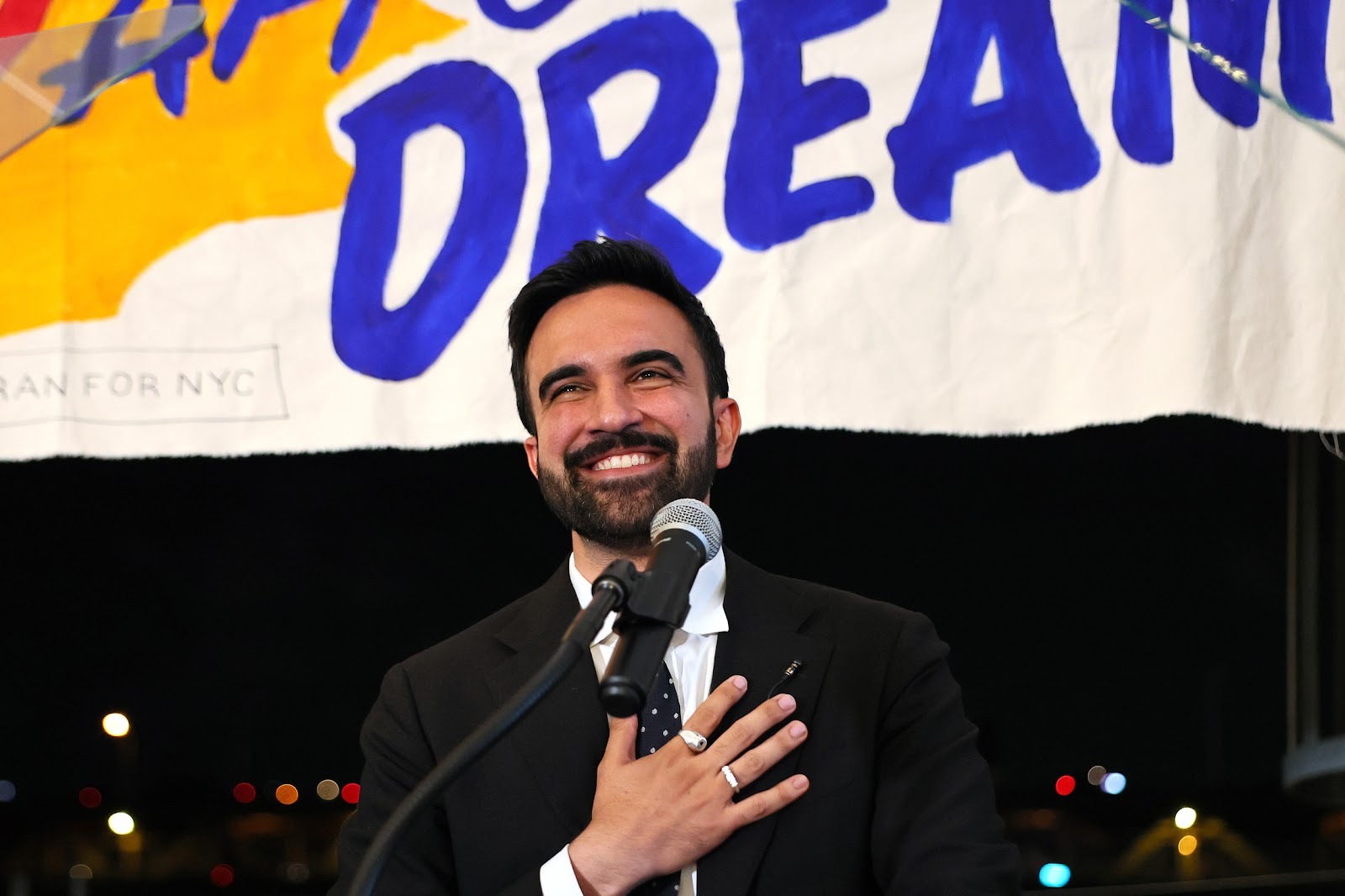
Mamdami appeared from practical anonymity into a pillar of faith for the Democratic supporters of New York, stating himself: “Today we have spoken in a clear voice: hope is alive.” Mamdani’s youth and remorseless alliance with the left-wing provided liberals of New York with the opportunity they needed to demonstrate their views in a Republican dominated government.
Connection with Younger Voters
Mamdani’s social media presence was considered an influential factor in his support from younger voters, despite being called a radical communist by right-wing President Donald Trump. However, Mamdani’s loyalty towards his party did not fade, and after winning the election, he addressed Trump by saying: “Donald Trump, since I know you’re watching, I have four words for you: Turn the volume up. To get to any of us, you will have to get through all of us.”
Rent Freeze Plan
New York is largely deemed to be an extremely unaffordable city, with the exorbitant prices of housing being a common protest by many New Yorkers. The average rent for a one-bedroom apartment in Manhattan in November 2025 was around $4,800 USD, around a 20% increase from three years ago. In Brooklyn, the average rent for the same space was around $3,600 USD, a 5% increase from three years prior. Mamdani plans on freezing rent during the next four years for the city’s one million rent-stabilized apartments. “This is a city where one in four of its people are living in poverty, a city where 500,000 kids go to sleep hungry every night,” stated Mamdani when addressing his plans as mayor of New York City.
Pledges on Groceries, Childcare, and Buses
Mamdani has pledged to create a network of city-owned grocery stores, make public buses free (and more efficient), lower the cost of childcare, raise the minimum wage (up to $30 from $16.50 per hour by 2030), and increase the corporate tax rate from 7.25% to 11.5%. However, many economists have criticized these ideas for being unrealistic and economically unviable. For example, Mamdani estimated that his plan to make public buses free would cost the city around $630 million per year, numerous people have pointed out that it will be close to $1 billion. Mamdani has voiced his goals on increasing the quality of life through expanding city mental health services, particularly through allowing mental health workers to respond to related 911 calls instead of the police department.
Concerns Surrounding Mamdani’s Plans

Image Courtesy of Rolling Stone
While Mamdani’s plans seem optimistic: a cheaper city, with a high quality of life, better income distribution, and opportunities for all, it is important to consider economic setbacks that reduce the viability of his goals. For example, government-owned grocery stores may result in inefficiency (as firms are not working towards profit), and free buses can lead to massive overcrowding as well as squatting by individuals without secure homes. In terms of frozen rents, this may result in a massive shortage of homes, as landlords no longer see a motive to rent out their properties for low prices. This may lead to a housing crisis, where a lottery system or a first-come, first-served basis may have to be employed to distribute property. Otherwise, the government may have to increase supply of houses themselves to dispose of the shortage, meaning a huge amount of money is necessary for investment, resulting in a lack of funds for other vital services (education, healthcare, etc). Mamdani needs to consult with numerous financial advisors, economists, and strategists to implement his plans in a feasible manner where his original promises are upheld.
Works Cited
Dalban, Lauren. “Zohran Mamdani Made Addressing Climate Change Central to His Affordability Plan for New York – inside Climate News.” Inside Climate News, 3 July 2025, insideclimatenews.org/news/03072025/new-york-zohran-mayoral-candidate-mamdani-climate-change/.
Klee, Miles. “Zohran Mamdani Misinformation, Debunked: Antisemitism, Immigrant Status.” Rolling Stone, 2 July 2025, www.rollingstone.com/politics/politics-features/zohran-mamdani-misinformation-antisemitism-1235376681/.
Pilkington, Ed. “How Mamdani Built an ‘Unstoppable Force’ That Won over New York.” The Guardian, The Guardian, 6 Nov. 2025, www.theguardian.com/us-news/2025/nov/06/zohran-mamdani-campaign-new-york-democrats.
Tabor, Nick. “Zohran Mamdani | New York City Mayoral Race, Democratic Socialism, Position on Palestine, Biography, & Parents.” Encyclopedia Britannica, 18 July 2025, www.britannica.com/biography/Zohran-Mamdani.