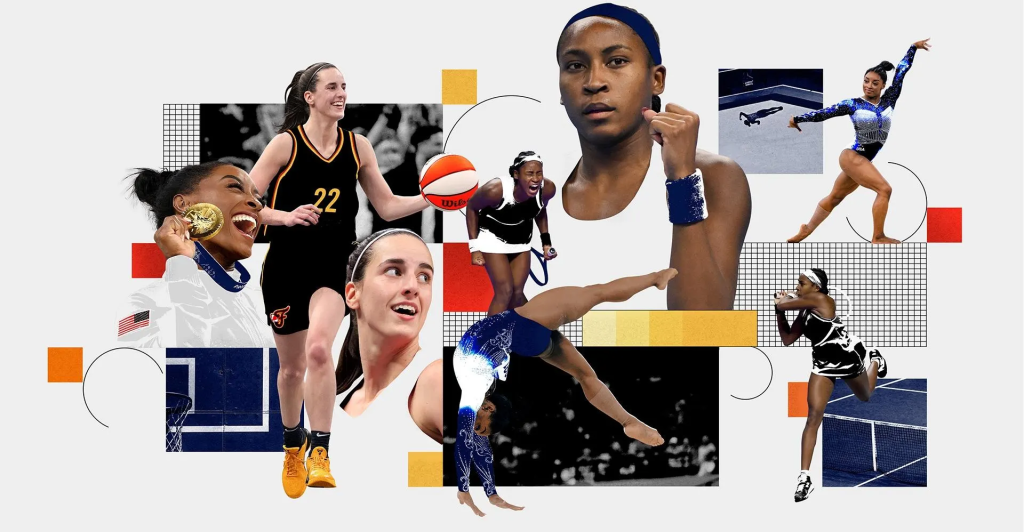
Same Game, Unequal Pay: The Persistent Gender Pay Gap in Sports
(Image courtesy of Knight, Brett. The World’s Highest-Paid Female Athletes 2024. 2024, Forbes Australia.)
In 1972, Billie Jean King, one of the most influential tennis players in the world, won the U.S. Open, but earned only $10,000, less than half of the $25,000 awarded to the men’s champion, Ilie Nǎstase. What should have been a moment that marked her greatness instead exposed one of sport’s greatest inequalities. Outraged, she swore not to play the next year unless the prize money was equal. In the next year, the U.S. Open became the first major tournament to offer equal pay for men and women (Akabas). However, this kind of fairness is still rare. In most sports, women earn less than men for the same performances.
The gender pay gap in sports means that male and female athletes are paid very unfairly. This includes salaries, prize money, sponsorships, and bonuses. While some sports, like tennis, have reached equal prize money at larger tournaments, the gap is still massive in others. A prime example of this is soccer. A 2017 global survey found that the combined salaries of 1,693 female players in seven major leagues were just slightly more than what one male player, Neymar, whose annual salary at Paris Saint-Germain exceeded $40 million, earned in a single year (Africa and Europe).
So why does this gap still exist? Many people say it’s because men’s sports bring in more money through ticket sales and TV deals. Although that’s partly true, it misses the bigger picture. For decades, women’s sports haven’t received the same investment, marketing, or media support. With less promotion and fewer resources, it’s considerably harder for the women’s league to grow, keeping the pay gap in place. As one study explains, when female athletes get less media attention, their market value drops, which means fewer sponsorships and smaller paychecks (Yingnan and Guoliang).
The link between media coverage and pay inequality is clear. A 2024 report by the Victorian Government found that 15% of all sports news coverage in Victoria focused on women’s sport, compared to 81% for men’s sports. That means there are over five stories about men’s sports for every one about women’s. Even when women’s sports were covered, stories were shorter, lacked deeper analysis, and often focused on unrelated topics such as appearance or personal life rather than skill and achievement (Victoria State Government). The study also found that women journalists were 62% more likely than men to cover women’s sports but because men still dominate newsroom leadership, coverage decisions often continue to favor men’s leagues (Victoria State Government).
The issue goes deeper than coverage. Sports have long been dominated by men, both on the field and in governance. Women were excluded from the first modern Olympic Games in 1896, and even today, they remain severely underrepresented in leadership roles. For example, only 38 of the International Olympic Committee’s 152 members are women, and in the European Union, women held just 14% of top decision-making positions in sports federations in 2015. Without women in leadership positions, policies that support equal funding, marketing, and pay often get ignored (Africa and Europe).
Despite these challenges, there are recent improvements that have been made. According to the World Reviews report, 83% of sports worldwide now offer equal prize money or pay for men and women—a major improvement compared to just a few years ago. Today, tennis, athletics, rowing, and surfing have achieved full pay equality, and sports like cricket, cycling, and badminton are catching up fast (The World Reviews). Even though many sports still lag behind, the direction of change is clear. Equal pay is no longer a distant goal but an active movement reshaping sports culture.
References
Africa, Americas, and Asia Europe. AT a GLANCE Infographic GENDER EQUALITY in SPORTS: (SLOWLY) CHANGING the GAME WOMEN in SPORTS GOVERNANCE STRUCTURES 6.5 % 6.5 % 4 % 4 % 2 % 2 % 4 % 8 % 8 % Female Members Female Honorary Members EU-27 (6 %) Women in the International Olympic Committee. 2020.
Akabas, Lev. “U.S. Open’s Equal Pay Can’t Close the Tennis Gender Gap.” Sportico, 8 Sept. 2023, www.sportico.com/leagues/tennis/2023/us-open-prize-money-gender-pay-gap-1234736498/.
Change Our Game. “The Conversation of Sport: Representation of Women in Sports News Coverage 2023-24.” Change Our Game, 2023, changeourgame.vic.gov.au/insights/the-conversation-of-sport-2023-24.
Knight, Brett. “The World’s Highest-Paid Female Athletes 2024.” Forbes Australia, 19 Dec. 2024, www.forbes.com.au/news/sport/the-worlds-highest-paid-female-athletes-2024/.
“The Hundred: PCA Report Says Gender Pay Gap “Cannot Be Allowed to Continue.”” BBC Sport, 6 Mar. 2025, www.bbc.com/sport/cricket/articles/cm2dkz21y77o.
The World Reviews. “Top 10 Sports Closing the Gender Pay Gap in 2025: A Long Fight Finally Gaining Ground.” Medium, 31 July 2025, medium.com/@worldreviews3/top-10-sports-closing-the-gender-pay-gap-in-2025-a-long-fight-finally-gaining-ground-d7496880ef94.
Victoria State Government. Representation of Women in Sports News Coverage. 2023.
Yingnan, Sun, and Wang Guoliang. “Gender Disparities in Sports Media Coverage: Phenomenon, Analysis, and Transformation.” Frontiers in Sport Research, vol. 5, no. 9, 1 Jan. 2023, francis-press.com/uploads/papers/jORzGBukcSSiORBkHshtjf6FaumNqmIqkQe0fTxj.pdf, https://doi.org/10.25236/fsr.2023.050904.